

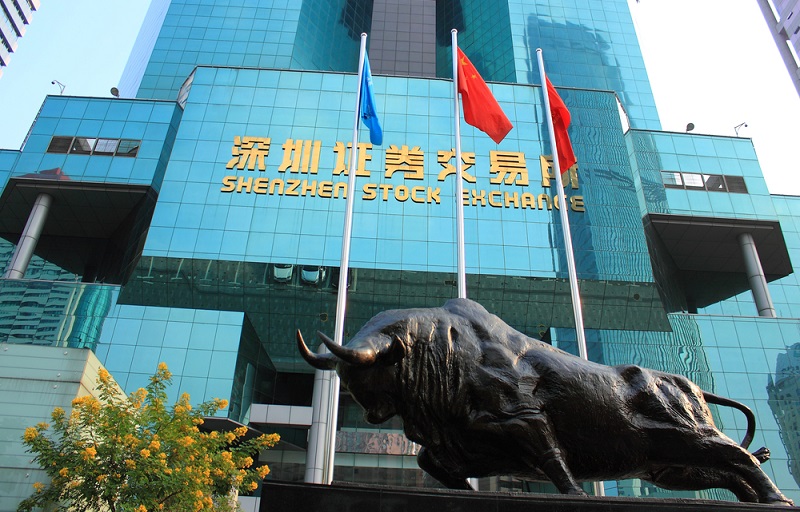
The Shanghai Stock Exchange (SSE) is the cornerstone of mainland China’s financial system. It lists shares of the country’s largest banks, industrial, energy, telecom, and consumer companies. Its dedicated technology board — the STAR Market — serves as a key platform for innovative enterprises to raise capital.
Unlike fully open international exchanges, the SSE combines exchange mechanisms with foreign exchange controls, special access channels for foreign investors, and a prominent role for the state. As a result, SSE’s performance reflects not only business sentiment but also shifts in China’s economic and regulatory policy.
- What Is the Shanghai Stock Exchange?
- How Is the SSE Market Structured?
- Which Companies Are Listed on the SSE?
- How Does Trading Work?
- What Are A-Shares and B-Shares?
- How Can Foreign Investors Access the SSE?
- Key Advantages and Features of the SSE
- Major SSE Indices
- Why Global Investors Monitor the SSE
What Is the Shanghai Stock Exchange?
The modern Shanghai Stock Exchange was established on November 26, 1990, and began official trading on December 19 of the same year. However, organized securities trading in Shanghai dates back much earlier: operations began in the 19th century, and the Shanghai Stockbrokers’ Association was founded in 1891.
The SSE operates under the supervision of the China Securities Regulatory Commission (CSRC). The exchange organizes trading, sets listing and trading rules, oversees information disclosure, and performs frontline market surveillance.
As of July 2026, the total market capitalization of SSE-listed equities stood at approximately ¥62.8 trillion. This figure changes daily. In 2025, financial results were disclosed by 2,314 SSE-listed companies, reporting combined revenue of ¥51.09 trillion and net profit of ¥4.46 trillion.
How Is the SSE Market Structured?
The Shanghai equity market consists of two main segments: the Main Board and the STAR Market.
Main Board — the exchange’s primary market — hosts large, long-established enterprises: banks, insurers, oil & gas corporations, telecom operators, industrial conglomerates, transportation firms, and consumer companies.
This segment is often viewed as China’s “blue-chip” market. In 2025, Main Board companies generated ¥49.49 trillion in revenue and ¥4.40 trillion in net profit. Firms included in the SSE 180 Index accounted for nearly 70% of Main Board revenue and over 90% of its net profit.
STAR Market, officially the Science and Technology Innovation Board, launched in 2019 to facilitate capital raising for tech-driven and innovative firms. It features semiconductor manufacturers, equipment makers, software developers, biotech, and healthcare companies.
By May 2026, the STAR Market hosted 609 companies with a combined market value exceeding ¥13 trillion. In 2025, their revenue rose 10.3% to nearly ¥1.6 trillion, while net profit surged 26.6% to over ¥58.6 billion.
The SSE also supports trading in:
- Government and corporate bonds;
- Exchange-traded funds (ETFs);
- Public infrastructure REITs;
- Money market funds;
- Repo transactions;
- Options on select ETFs;
- Depositary receipts and other approved instruments.
Thus, the Shanghai Stock Exchange functions not only as an equity market but also as a major infrastructure hub for debt, fund, and derivatives markets.
Which Companies Are Listed on the SSE?
SSE’s composition broadly mirrors mainland China’s economic structure. The Main Board is dominated by large financial institutions, energy, industrial, construction, transport, and telecom enterprises — many state-controlled or with significant government ownership.
Listed issuers include China’s largest banks, oil & gas giants, telecom operators, equipment manufacturers, and leading consumer corporations. This distinguishes the SSE from the U.S. Nasdaq, where private tech platforms and software firms are more heavily represented. The Shanghai Main Board remains more sensitive to banking, capital-intensive industry, and state-owned enterprise performance.
That said, the composition is evolving. According to official SSE data, the share of technology and innovation-focused companies among issuers with market caps above ¥100 billion is rising. By May 2026, 132 such companies were listed on the SSE, with a combined market value of ¥46.14 trillion — about 59% of the total SSE market cap at that time.
The growth of the STAR Market strengthens representation in semiconductors, artificial intelligence, biomedicine, robotics, and high-end equipment. Yet traditional sectors continue to drive overall market dynamics and major index performance.
How Does Trading Work?
The primary trading currency for SSE equities is the Chinese yuan (CNY).
The exchange operates Monday through Friday, excluding public holidays and pre-announced non-trading days. Regular equity trading hours for both the Main Board and STAR Market (Beijing time) are:
- 9:15–9:25 — Opening auction;
- 9:30–11:30 — Morning continuous session;
- 13:00–14:57 — Afternoon continuous session;
- 14:57–15:00 — Closing auction.
The STAR Market offers an additional post-market fixed-price session from 15:05 to 15:30.
Daily price limits are a distinctive feature of China’s equity market. For most Main Board stocks, the daily price change is capped at ±10% relative to the previous day’s closing price. Stocks under special surveillance face narrower limits; in certain cases defined by regulation, price limits may be temporarily suspended. On the STAR Market, the standard daily limit is ±20%. During the first five trading days after IPO, no price limits apply.
These limits aim to curb extreme intraday volatility but do not eliminate market risk. Under strong supply-demand imbalances, a stock may hit its upper or lower bound for multiple consecutive days, hindering timely position entry or exit.
What Are A-Shares and B-Shares?
The majority of the SSE market comprises A-shares — equity securities denominated and traded in Chinese yuan. A-shares constitute the core components of major SSE indices and are accessible to foreign investors via dedicated channels, including the Shanghai–Hong Kong Stock Connect.
B-shares on the Shanghai Stock Exchange are quoted in U.S. dollars. This segment is significantly smaller than the A-share market and carries limited weight in SSE’s total market capitalization and trading volume. Official rules set the minimum price increment at ¥0.01 for A-shares and $0.001 for B-shares.
The A/B classification originated during China’s gradual opening to foreign capital. As the Stock Connect program and Qualified Foreign Institutional Investor (QFII) regime matured, the B-share channel’s relevance as a standalone access route declined.
How Can Foreign Investors Access
FAQ
What are A-shares and B-shares on the SSE?
A-shares are yuan-denominated equities forming the core of the SSE and accessible to foreign investors via channels like Shanghai–Hong Kong Stock Connect; B-shares are U.S. dollar-denominated, smaller in scale, and less relevant today.
How do daily price limits work on the SSE?
Main Board stocks have a ±10% daily price limit relative to the prior close; STAR Market stocks have ±20%, with no limits during the first five trading days after IPO.
Can foreign investors trade directly on the SSE?
No—foreign investors access the SSE indirectly through regulated channels such as Shanghai–Hong Kong Stock Connect, QFII, or RQFII, subject to China’s capital account rules and exchange controls.