On the map of global financial centers, NASDAQ holds a unique position—not just as a stock exchange, but as the symbolic core of the digital economy, technological advancement, and rapid growth of companies built on innovation, data, and scalable tech-driven business models.
NASDAQ is where stocks become ideas—and ideas become capital. For investors, it serves both as a real-time sentiment barometer for the high-tech sector and as a strategic indicator of broader global market direction.
Contents
- History of NASDAQ
- Key Features of the NASDAQ Exchange
- How NASDAQ Is Structured
- NASDAQ Indices
- Investing in NASDAQ
- Conclusion: The Digital Pulse of Global Markets
History of NASDAQ
The foundation of what would become a global phenomenon began in the late 1960s, when the U.S. National Association of Securities Dealers (NASD) was tasked with automating and systematizing the over-the-counter (OTC) securities market. This initiative aligned perfectly with the rise of computer technology—and what began as an automated quotation system quickly evolved into a full-fledged stock exchange.
In 1982, NASDAQ launched its Nasdaq National Market—listing companies meeting stringent listing requirements. Two years later, it introduced the Nasdaq Small Cap Market for smaller-capitalization firms. It also rolled out systems for executing small orders, implemented limit-order protection rules, and enabled margin trading. These innovations propelled NASDAQ into direct competition with the venerable New York Stock Exchange (NYSE) within the next decade.
In the 1990s and early 2000s, NASDAQ acquired the third-largest U.S. exchange, AMEX, and attempted to expand into Europe—most notably through a protracted bid for the London Stock Exchange. Though that effort ultimately failed, NASDAQ secured a 30% stake and became its largest shareholder. Following this setback, NASDAQ turned its attention to the Baltic region—acquiring Sweden’s OMX exchange and a one-third stake in St. Petersburg’s IXCP exchange. The merged entity became NASDAQ OMX Group, now operating eight exchanges worldwide. In the 21st century, NASDAQ cemented its status as the premier financial home for tech giants, venture-backed IPOs, and digital-first corporations.
Key Features of the NASDAQ Exchange
NASDAQ’s defining characteristic is its strong focus on technology companies—listing on NASDAQ remains a prestigious milestone for IT-driven firms. Microsoft, Nokia, and Apple are globally recognized names that exemplify this identity. Its listing roster is truly international, including major European and Asian economic leaders.
NASDAQ’s success stems from its pioneering adoption of electronic trading systems—enabling faster order execution, anonymity, flexibility, lower transaction costs, and crucially, near-24/7 trading at prices closely aligned with prevailing market levels. As a result, NASDAQ’s innovations in electronic markets have been widely emulated by leading exchanges around the world.
How NASDAQ Is Structured
Unlike traditional exchanges with physical trading floors, NASDAQ was designed from inception as a fully electronic platform. All trades occur via a network of brokers, dealers, and market makers.
There is no trading floor like NYSE’s iconic hall. Instead, dozens of competing market makers and algorithmic systems vie to execute orders at the best available price—reducing spreads and accelerating trade execution.
NASDAQ organizes its listings across three tiers:
- Global Select Market — for the largest, most stable, and financially robust companies
- Global Market — for mid-cap companies meeting rigorous standards
- Capital Market — for emerging and smaller issuers, including high-potential startups
This tiered structure allows NASDAQ to simultaneously attract fast-growing startups and multinational corporations—balancing accessibility with credibility.
NASDAQ Indices
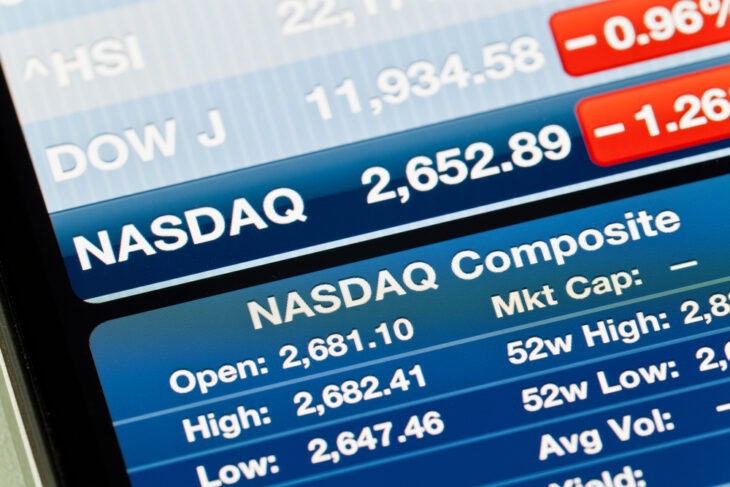
NASDAQ-100 Index is the exchange’s most prominent benchmark. It tracks exactly 100 non-financial companies representing the “new economy”—spanning sectors such as tech, biotech, consumer services, and communications. Its calculation uses a modified market-cap weighting, with quarterly rebalancing and an additional adjustment factor applied to each constituent to prevent excessive concentration. The index also powers numerous sector-specific sub-indices—including Nasdaq Financial-100, Nasdaq Industrial, Nasdaq Transportation, Nasdaq Bank, Nasdaq Telecommunications, Nasdaq Insurance, Nasdaq Computer, Nasdaq Other Finance, and Nasdaq Biotechnology. Today, it underpins popular ETFs and derivatives—and is widely used by institutional investors. One of the most well-known ETFs tracking the NASDAQ-100 is QQQ, offering broad exposure to the technology and innovation ecosystem.
The NASDAQ Composite Index—often simply called “the NASDAQ”—is a broad-market index covering all domestic and foreign common stocks listed on NASDAQ. It includes over 3,000 companies, with heavy representation from technology, biotechnology, and telecommunications sectors.
Investing in NASDAQ
Investors view NASDAQ as a primary venue for long-term growth—especially in alignment with structural tech trends. However, higher potential returns come with elevated risk. NASDAQ-listed stocks tend to be highly volatile and sensitive to interest rate shifts, macroeconomic data releases, and overall market sentiment. Sector overheating can trigger sharp corrections—evident in historical drawdowns during tech bubbles.
NASDAQ has long transcended U.S. borders: over one-third of its trading volume comes from international funds and traders. The exchange actively promotes listings of foreign companies—particularly from Asia and Europe—offering them access to one of the world’s deepest and most liquid capital markets. Moreover, the behavior of the NASDAQ Composite has become a key reference point for global portfolio strategies. For many fund managers, it serves as the first signal of risk-asset health and innovation-sector momentum.
Conclusion: The Digital Pulse of Global Markets
NASDAQ is more than a stock exchange—it is the emblem of an era where technology shapes the future and information functions as the new currency. It stands at the epicenter of the global economy’s digital transformation. Every investor engaging with NASDAQ isn’t merely buying shares in individual firms—they’re investing in the very idea of progress.
In this sense, NASDAQ is neither just an index nor just a marketplace. It is a movement—a reflection of the pace, risk, and opportunity inherent in the 21st century. And as long as technology continues reshaping our world, NASDAQ will remain at its forefront.
“,
“excerpt”: “NASDAQ is the world’s leading tech-focused stock exchange—home to Apple, Microsoft, and thousands of innovative firms. Learn how it works, its key indices, and investment implications.”,
“slug”: “nasdaq-tech-heartbeat-global-markets”,
“short_description”: “NASDAQ is the premier global exchange for tech stocks, indices, and innovation-driven investing—explaining
FAQ
What makes NASDAQ different from the NYSE?
NASDAQ is fully electronic with no physical trading floor, relies on competing market makers and algorithms, and has a strong focus on technology and growth-oriented companies—unlike the NYSE’s hybrid (floor + electronic) model and broader sector representation.
What is the difference between the NASDAQ Composite and the NASDAQ-100?
The NASDAQ Composite includes all domestic and foreign common stocks listed on NASDAQ (over 3,000 companies), while the NASDAQ-100 tracks only 100 of the largest non-financial firms—primarily tech, biotech, and consumer services—using a modified market-cap weighting.
Can international companies list on NASDAQ?
Yes—NASDAQ actively encourages foreign listings, especially from Europe and Asia, offering access to deep liquidity and global investor interest; over one-third of its trading volume comes from international participants.