


The Bank for International Settlements (BIS) Triennial Central Bank Survey is one of the most comprehensive sources of data on the size and structure of global over-the-counter (OTC) foreign exchange and interest rate derivatives markets. Its purpose is to enhance transparency in these markets and help central banks, regulators, and market participants monitor developments in the global financial system.
FX market activity has been surveyed every three years since 1986; OTC interest rate derivatives data collection began in 1995. The survey is coordinated by the BIS: the FX component is conducted under the auspices of the Markets Committee, and the interest rate derivatives component under the Global Financial Systems Committee. It also supports the G20-endorsed initiative to close data gaps.
The 2025 statistical report covers the FX portion of the Triennial Survey. Data collection took place in April 2025 and involved central banks and other authorities from 52 jurisdictions. They gathered information from over 1,100 banks and other dealers and submitted national aggregated data to the BIS for compilation into global statistics.
Turnover was measured at the trading desk level of reporting dealers, regardless of where trades were executed. Data are reported on a non-consolidated basis—i.e., intercompany trades within the same group are included.
Data for 2025 are preliminary and subject to revision. Final turnover figures and analytical commentary will be published in the December 2025 issue of the BIS Quarterly Review. A separate report on outstanding notional amounts as of June 2025 was scheduled for publication in November 2025.
Key Findings of the 2025 Survey
- In April 2025, daily turnover in the global OTC foreign exchange market reached $9.6 trillion, covering all FX instruments combined. This represents a 28% increase from the $7.5 trillion average daily turnover recorded in the 2022 survey.
- Spot trading volume rose by 42%, while forward trading volume increased by 60%. Their shares of total global FX turnover rose from 28% to 31% (spot) and from 15% to 19% (forwards), respectively. FX options turnover more than doubled. FX swaps grew more modestly, reducing their share from 51% in 2022 to 42% in 2025.
- The US dollar retained its dominant position, appearing on one side of 89.2% of all trades in April 2025—up slightly from 88.4% in 2022. Euro share declined from 30.6% to 28.9%, while the Japanese yen remained nearly unchanged at 16.8%. The British pound fell to 10.2%. In contrast, the Chinese yuan and Swiss franc gained ground, reaching 8.5% and 6.4% respectively.
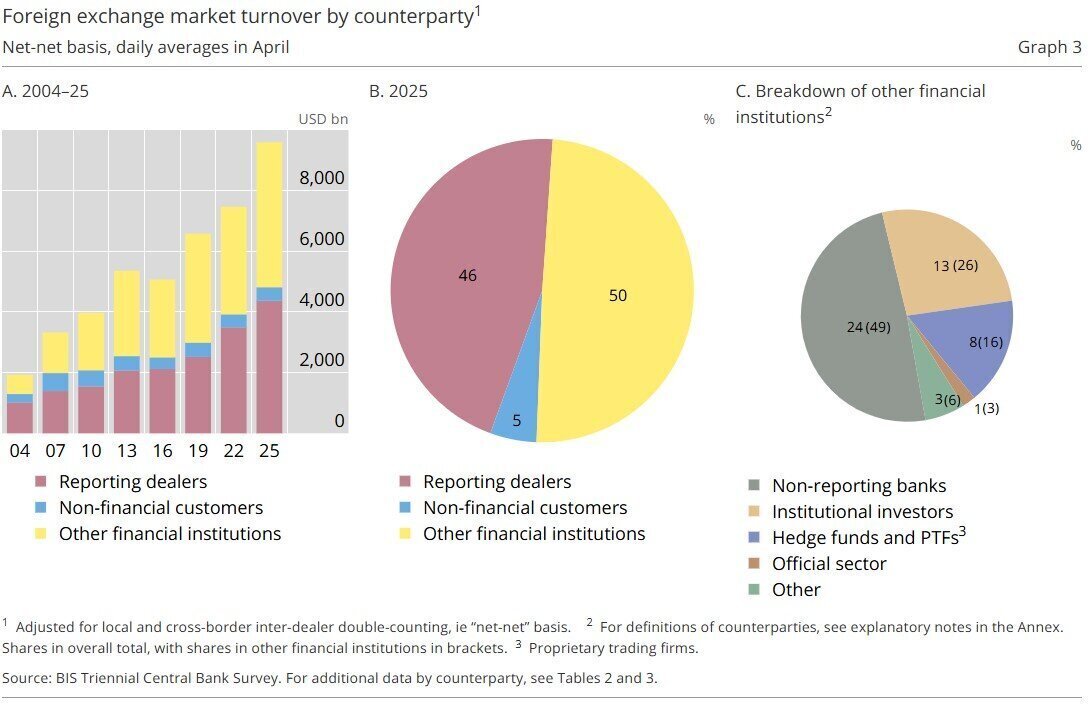
- Interdealer trading accounted for 46% of global FX turnover—nearly unchanged from 47% in 2022. Trading with other financial institutions rose to 50% from 47% three years earlier. Turnover with this counterparty group reached $4.8 trillion per day—35% higher than in 2022, driven primarily by a 72% rise in forwards and a 50% increase in spot transactions.
- Trading desks in the four largest jurisdictions—United Kingdom, United States, Singapore, and Hong Kong—accounted for 75% of gross global FX turnover, excluding local double-counting. Singapore’s role grew notably: its share rose to 11.8% from 9.5% in 2022.
Global FX Turnover in April 2025
Daily turnover in the global OTC foreign exchange market stood at $9.6 trillion in April 2025—28% higher than the $7.5 trillion recorded in the previous triennial survey in 2022.
The survey occurred amid elevated FX volatility and a surge in trading activity. At the start of April 2025, major jurisdictions announced trade policy measures that intensified FX market movements and influenced overall transaction volumes.
Turnover by Instrument
The FX turnover mix shifted toward spot and forward transactions. In April 2025, spot transactions accounted for 31% of global FX turnover—up from 28% in 2022.
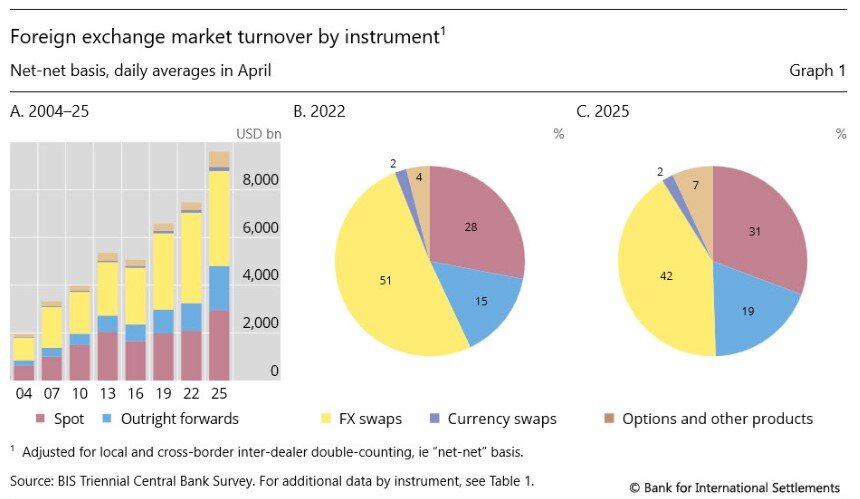
Forward transactions, used by market participants to lock in future exchange rates, reached $1.8 trillion per day. Their share rose to 19% of total turnover from 15% in 2022.
FX swaps remained the most actively traded instrument. Their average daily turnover rose to $4.0 trillion in April 2025, up from $3.8 trillion in April 2022. Despite absolute growth, their share declined to 42%—as other instruments expanded faster.
FX swaps typically combine a spot transaction with a forward transaction for a later date. Most are short-term—maturing within seven days—and widely used for managing FX liquidity, funding, and hedging FX risk.
FX options turnover more than doubled between 2022 and 2025, reaching 7% of global FX turnover—up from 4% previously. These instruments serve both hedging and speculative purposes.
FX-interest rate swaps remained relatively stable at around 2% of the total market. These instruments are commonly used for long-term cross-currency funding needs and FX risk hedging. Due to longer maturities, their average daily turnover is typically lower than that of FX swaps and forwards.
Turnover by Currency and Currency Pair
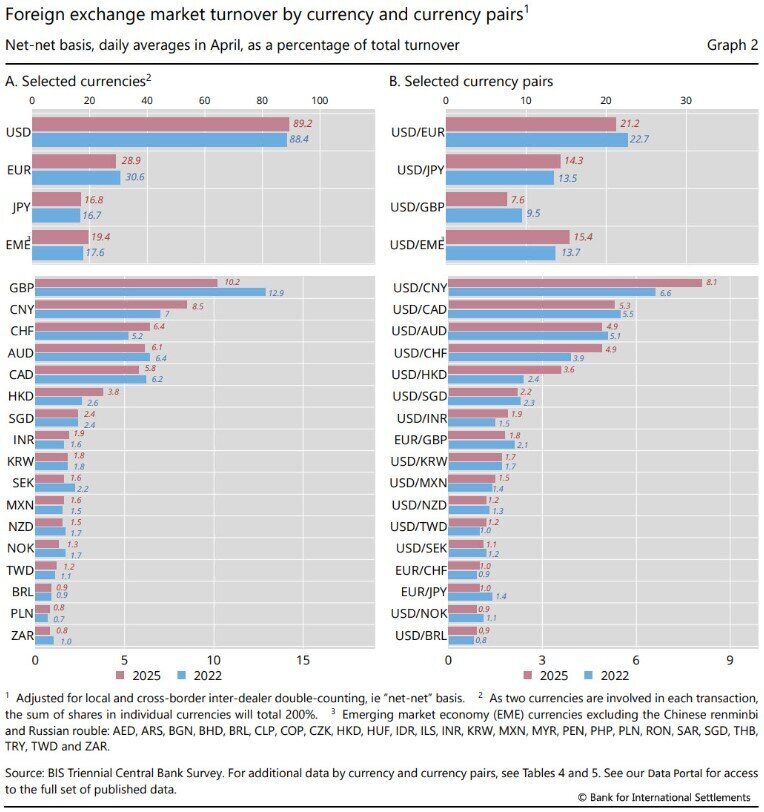
US dollar remained the world’s primary currency. In April 2025, it appeared on one side of 89.2% of all FX transactions—up from 88.4% in 2022.
Euro share declined to 28.9%, down from 30.6% in 2022 and 32.3% in 2019. The Japanese yen held steady near 16.8%, unchanged from prior surveys.
Among the next most-traded currencies, notable shifts occurred for the British pound, Chinese yuan, and Swiss franc. Yuan share continued its upward trend—observed since 2013—and reached 8.5% of global turnover. The Swiss franc rose to 6.4%, securing sixth place among most-traded currencies. The British pound share fell to 10.2%, below the ~13% average seen in the three prior surveys (2016–2022).
The Australian dollar, Canadian dollar, and Singapore dollar maintained relatively stable positions—each holding roughly 6%, 6%, and 2% shares, respectively. The Hong Kong dollar showed stronger growth: its share rose from 2.6% in 2022 to 3.8% in
FAQ
What is the BIS Triennial Central Bank Survey?
It is a comprehensive, triennial survey conducted by the Bank for International Settlements to measure global OTC foreign exchange and interest rate derivatives market activity, supporting transparency and financial stability monitoring.
How much did daily FX turnover increase between 2022 and 2025?
Daily global FX turnover rose 28% from $7.5 trillion in 2022 to $9.6 trillion in April 2025, according to preliminary BIS data.
Which currency gained the most ground in the 2025 survey?
The Chinese yuan’s share of global FX turnover increased to 8.5%, continuing its upward trend since 2013; the Swiss franc also rose to 6.4%, becoming the sixth most-traded currency.