





 Foreign preferred stocks
How do preferred stocks differ from common stocks?
The advantage of preferred stocks lies in the right to:
- Receive a fixed income, either as a percentage of the stock’s value or a specific amount of money paid regardless of the company’s performance. Common stockholders learn about dividend payments and their amount periodically, depending on the board of directors’ decision.
- Receive dividends first;
- Have priority in the distribution of the company’s assets during liquidation, after creditors (banks and bondholders) have been satisfied;
- Receive additional payments if the dividend amount paid for common stocks exceeds the dividend amount for preferred stocks.
- Have certain advantages in converting their securities into common stocks when necessary.
Owners of preferred stocks often do not have voting rights at shareholders’ meetings, but in some cases, these owners can still participate in voting.
What types of preferred stocks are there?
- Cumulative, which have the right to accumulate unpaid dividends, accrue them, and pay them in the next period after the missed one;
- Non-cumulative, where unpaid dividends are not added to the dividends of subsequent years;
- Convertible, which can be exchanged for a set number of common stocks or bonds of the company;
- Non-convertible, which cannot change their status;
- Participating, which give the right to receive additional dividends beyond those specified if the dividends for common stocks are higher.
Are there disadvantages to preferred stocks?
- The issuing company may require the shareholder to return these stocks without explanation, fully compensating for any loss with interest;
- With rare exceptions, preferred stocks do not grant voting rights at meetings;
- They are less liquid than common stocks because fewer preferred stocks are usually traded on the market;
- Preferred stocks are not traded on foreign markets and are not included in global indices.
Rights of Preferred Stockholders
Despite the many important advantages of preferred stocks over common stocks and other company securities, their rights are still limited, such as the right to vote. However, they can attend meetings, allowing them to defend their rights when issues relate to their personal financial interests.
In addition, such investors have the right to a proportional share of the company’s capital. They also have priority in claiming the company’s assets during liquidation.
Where to Buy Preferred Stocks?
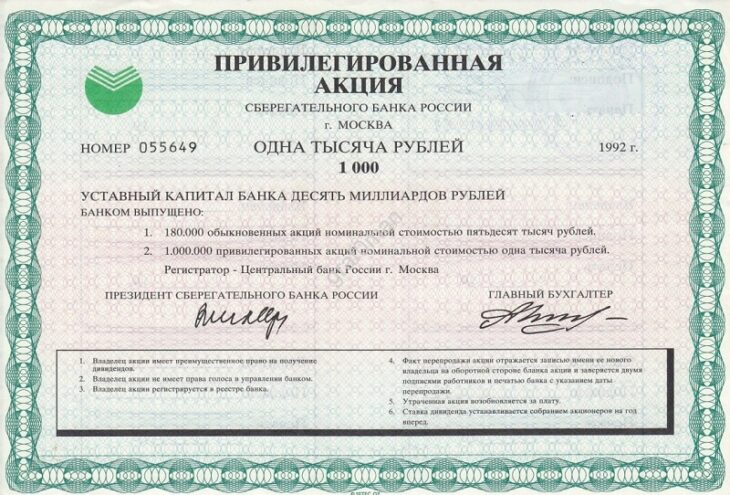 Preferred stock of Sberbank
Most large companies are interested in selling their assets to as many buyers as possible. Therefore, there are no problems in purchasing preferred stocks of Gazprom or Sberbank through numerous brokers.
Alternatively, you can use public resources of one of the exchanges where the corresponding securities of large firms are freely traded, for example, on MosBourse. For instance, preferred stocks of Sberbank today offer guaranteed returns (around 4-5%) and relatively low prices.
Which Stocks to Choose: Preferred or Common?
It depends on the specific situation each time. Prefs offer a more predictable dividend income, but they are less liquid, making it harder to profit from price differences. However, this can be beneficial for long-term investors.
FAQ
What are preferred stocks?
Preferred stocks are a type of equity that offers a fixed dividend and priority in asset distribution during liquidation.
Do preferred stocks have voting rights?
No, preferred stocks typically do not grant voting rights, though there are exceptions.
Are preferred stocks more stable than common stocks?
Yes, preferred stocks are generally more stable due to their fixed dividend payments and priority in claims during liquidation.