





This forex strategy is based, as the name suggests, on the MACD indicators and Stochastic Oscillator. By combining the strengths of both oscillators, traders gain an excellent tool for profitable trades.
Input Parameters
Market: Forex
Currency Pairs: Various
Indicators: Oscillator Stochastic, MACD
Trading Strategy: Indicator-based
Timeframe: H1
Protective Orders: StopLoss, TrailingStop
Core Principles of the Strategy
We’ll examine this strategy using the NZD/JPY cross pair as an example. After a decline over the past 24 hours, an upward trend emerged on Forex, as both the Stochastic and MACD oscillator turned upward.
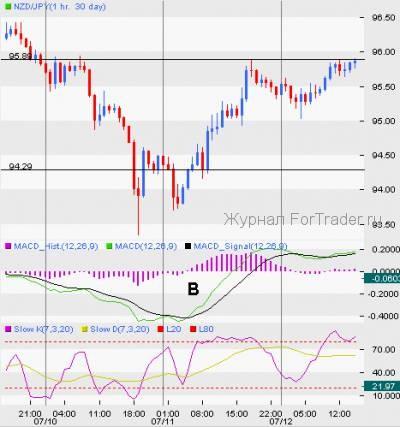
Apply the Stochastic indicator to the chart of the selected pair with parameters 7, 3, and 20, along with the MACD indicator. Use them to identify the trend: once the Stochastic D% line turns upward, look for growth or a crossover on the MACD, which reveals the longer-term trend.
Enter trades in the direction of the identified trend. In this case, we open a buy position since both the Stochastic Oscillator and MACD signal upward movement. Thus, our first trade opens at point B.
Monitor the trading position: once the conditions form, the buy position is captured, and we enter the market at the close of the hourly candle at the price level of 94.29. The StopLoss is placed below the session low at 94.01, following risk management principles.
This trade employed a TrailingStop to reduce risk during profit growth in case of a pullback or reversal against the position. The result was a profit of +159 pips until the positive StopLoss triggered.
The process for opening a sell trade is similar.
In summary, use the Stochastic indicator preferably for short-term forex trades, while the MACD works best for longer-term positions.