



Reversal patterns ‘Triple Top’ and ‘Triple Bottom’ have the same economic meaning as ‘Double Top’ and ‘Double Bottom’, with the difference that the price attempts to break a certain level three times to continue the original trend.
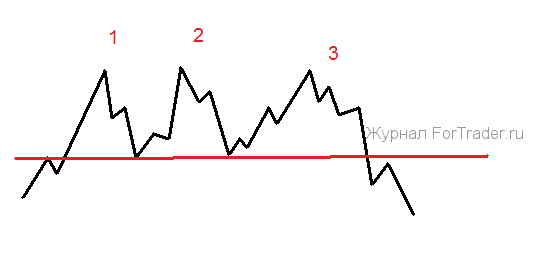
Formation of the ‘Triple Top’ Pattern
The mechanism of forming the ‘Triple Top’ reversal pattern is as follows: the price overcomes the resistance level, which then becomes support, and starts rising to a new resistance. Upon reaching it, the price pulls back to support and tries to rise again, but fails to overcome the previous peak and pulls back again. Unlike the double top, the price does not sell off, but makes another, third attempt to rise, which ends in failure, forming a third peak, after which the price begins to fall and breaks the support level, reversing the trend.

Execution of the ‘Triple Top’ Pattern
It is safer to enter when the price breaks the support level from top to bottom or when it tests it from below. Stop Loss should be placed above the peaks, and Take Profit should be measured by the distance from support to the peak levels.
Execution of the ‘Triple Bottom’ pattern is similar and mirrored.
FAQ
What is a Triple Top pattern?
A Triple Top is a reversal pattern where the price attempts to break a resistance level three times before reversing direction.
How is a Triple Bottom different from a Triple Top?
A Triple Bottom is the mirror image of a Triple Top, where the price attempts to break a support level three times before reversing upward.
How do traders use these patterns?
Traders use these patterns to identify potential trend reversals, placing stop-loss orders above the peaks for a Triple Top and below the troughs for a Triple Bottom.