




Shale oil is one of the most discussed phenomena in global energy over the past decades. Thanks to shale oil, the United States transformed from a major oil importer into one of the world’s leading exporters, completely changing the balance of power in the global market. Yet, despite the headlines, many people still don’t understand what shale oil is and why it generates so much discussion.
Simply put, shale oil is oil that does not lie in conventional underground “reservoirs,” but is trapped within dense rock formations resembling stone. It cannot be pumped out easily—engineers have learned to literally “crack open” underground rock using specialized technologies. This revolution has not only changed the energy landscape but also sparked heated debates about ecology, sustainability, and the future of global oil.
Contents
- Types of Shale Oil
- Shale Oil Extraction
- How Shale Oil Differs from Conventional Oil
- Economics of Shale Oil
- Impact on the Global Market
- 5 Key Facts About Shale Oil
Types of Shale Oil
Shale oil is a liquid hydrocarbon substance trapped within dense rock formations such as shales, argillites, or sandstones. Unlike conventional oil, which accumulates in large underground reservoirs and can be relatively easily extracted through wells, shale oil is found in microscopic pores and fractures within the rock. It is essentially “locked” in stone, and its extraction was impossible until recently.
In the modern energy industry, two main types of shale oil are distinguished based on extraction method:
- Tight Oil. This type consists of light hydrocarbon fractions and is found in rock layers with low permeability, which is the reason for its name. Extraction requires hydraulic fracturing and horizontal drilling technology.
- Shale Oil. This is extracted from kerogen—a special substance found in shale rock. Kerogen is essentially the precursor to conventional oil. To accelerate its conversion, kerogen is subjected to thermal treatment directly in the well, resulting in shale oil.
Shale Oil Extraction
Two main methods of shale oil extraction have become widespread:
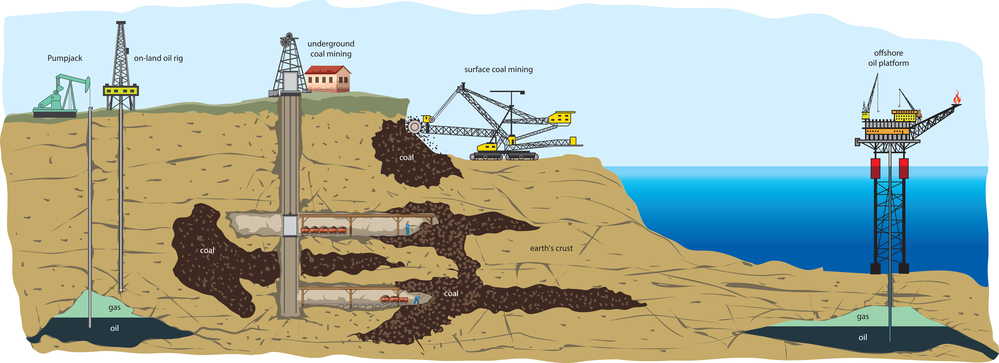
- Surface Extraction. In this method, oil-bearing rock is brought to the surface and processed in special facilities, where it is separated into oil fractions.
- Deep Underground Extraction. This method is used when oil-bearing rock is located at great depths. Horizontal drilling is employed, and water is injected under pressure into the well, causing hydraulic fracturing of the rock. The resulting network of fractures releases the oil, which is then pumped to the surface. It should be noted that hydraulic fracturing carries significant risks, including ground subsidence, seismic activity, and contamination of groundwater with oil and methane.
Combining these technologies has dramatically reduced extraction costs, making shale oil commercially viable. Thanks to this, the United States began rapidly increasing production in the early 2010s and became an energy leader within a few years.
How Shale Oil Differs from Conventional Oil
The main difference is that shale oil does not accumulate in a single large underground reservoir. Instead, it is distributed throughout microscopic cracks and pores in the rock. As a result, extraction requires constant drilling of new wells—old wells quickly deplete, usually within a year of starting production.
Chemically, shale oil is typically lighter and contains less sulfur than conventional oil, making it “cleaner” for refining. However, it is less stable during storage and oxidizes more quickly.
Economically and environmentally, shale oil extraction is more expensive. It requires large amounts of water, chemical reagents, and energy. There is also a risk of groundwater contamination and increased seismic activity in areas with intensive fracking.
Economics of Shale Oil
Production costs for shale oil are traditionally higher than for conventional oil. Depending on the region and technology, profitability typically begins at oil prices around $45–60 per barrel. When prices fall below this level, many companies operate at a loss.
However, there is a flip side. The flexibility of the shale industry allows for rapid increases or decreases in production. If prices rise, companies quickly drill new wells, helping to stabilize the market. As a result, shale oil has become a kind of “buffer” for the global economy, smoothing out price peaks and drops.
For the United States, this sector has become a source of millions of jobs, investment inflows, and energy independence. The country, which once depended on imports, now exports oil and gas.
Impact on the Global Market
The emergence of shale oil has transformed the global oil map. Previously, the market was dominated by OPEC countries, which controlled the majority of production. But with the rise of U.S. production, this balance shifted. When American companies began mass exporting oil, global prices dropped.
The effect was especially noticeable in 2014, when the shale revolution caused prices to nearly halve. OPEC was forced to revise its strategy, and competition between traditional and “new” producers intensified.
Moreover, thanks to shale oil, Western countries have reduced their dependence on Middle Eastern suppliers. This has changed not only the economy but also geopolitics.
5 Key Facts About Shale Oil
- Fact One. Experts estimate global shale oil reserves at about 300 billion barrels, with 24 billion barrels located in the United States. At current consumption rates, these reserves would last more than 300 years.
- Fact Two. Shale oil extraction is not economically viable everywhere. For extraction to be justified, oil-bearing shale must contain at least 90 liters of oil per ton of rock. In addition, the oil-bearing layer must be at least 30 meters thick. Fewer than one-third of shale oil deposits meet these criteria.
- Fact Three. Modern technologies allow extraction of 0.5 to 1.25 barrels of shale oil from one ton of oil-bearing shale rock.
- Fact Four. During the first year of operation, shale wells produce significantly more oil and gas than conventional wells. After the first year, efficiency drops by about 80%.
- Fact Five. The main production regions are Texas (Permian Basin), North Dakota (Bakken Formation), and southern United States (Eagle Ford). Together, these three regions account for the lion’s share of global shale oil production.
Despite the challenges, the potential of the shale industry is enormous. Technological advances are making extraction cheaper and safer. Companies are now actively introducing “smart fracking”—automating processes, reusing water, and analyzing data in real time.
In the coming years, the main growth is expected in the United States, China, and Argentina. Russia is also considering expanding production, but costs remain high for now.
Shale oil fits into the broader energy transition. While the world moves toward “green” energy, oil will remain a key player for a long time, and shale extraction can provide the flexibility and technological edge this sector needs.