



When the entire market is declining, but some stocks are rising, or when most securities are falling in price, how do you determine the depth of the decline? These questions highlight the need for financial benchmarks.

What Are Financial Benchmarks?
The word benchmark translates to ‘reference test’ and was originally used in the computer industry to evaluate PC performance.
Simply put, a benchmark is a reference point used to evaluate the condition of a particular area or sector.
Depending on the financial market, benchmarks can include various macroeconomic indicators, such as:
- Stock market – stock indices;
- Money market – central bank interest rates and interbank lending rates;
- Commodity market – prices of raw materials and food products, etc.
For investors in the stock market, the most relevant benchmarks are those for stocks and bonds.
Stock indices are divided into two groups:
- National indices – these include shares of leading companies from one country;
- Industry indices – these consist of shares of companies within the same industry.
Bond indices can be categorized as:
- Government;
- Corporate;
- Mortgage.
Reference Indicators on the Stock Market
All companies listed on the stock market belong to a specific industry. To better understand the state of an industry, each has its own reference indicator in the form of a stock index.
For example, on the American market, the Dow Jones indices include:
- Dow Jones Composite Average – overall composite index;
- Dow Jones Industrial Average – industrial index;
- Dow Jones Utility Average – utility sector index;
- Dow Jones Transportation Average – transportation and logistics sector index, among others.
On the Russian stock market, the main benchmarks are two indices:
- MOEX Index – based on the value of the most liquid shares of the largest and dynamically developing Russian issuers, expressed in Russian rubles;
- RTS Index – based on the prices of shares, expressed in US dollars.
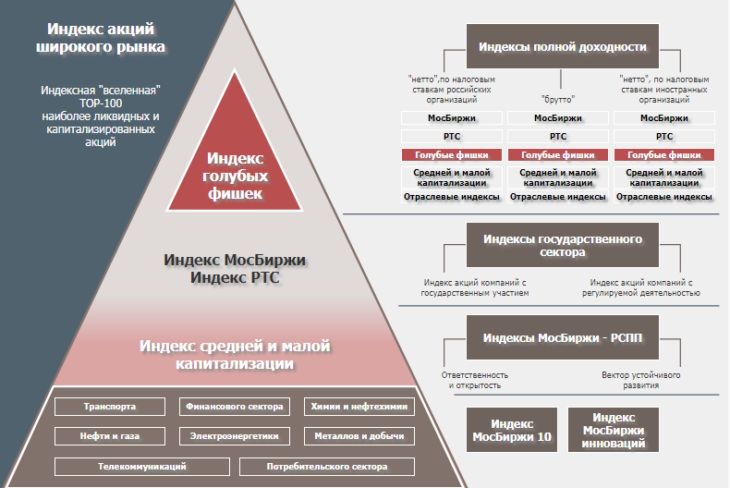 Russian benchmarks and the family of stock indices. Source: Moscow Exchange
How Investors Can Use Benchmarks
Benchmarks are also used to assess the effectiveness of an investment fund:
- If the fund’s return exceeds the growth of the overall stock index, the fund is considered effective;
- If the stock index outperforms the fund’s return, the investment is considered unsatisfactory.
Although stock indices cannot be traded directly on the exchange, many benchmarks serve as underlying assets for futures contracts. For example, on the Moscow Exchange, you can find futures on the RTS Index, MOEX Index, and the Blue Chip Index:
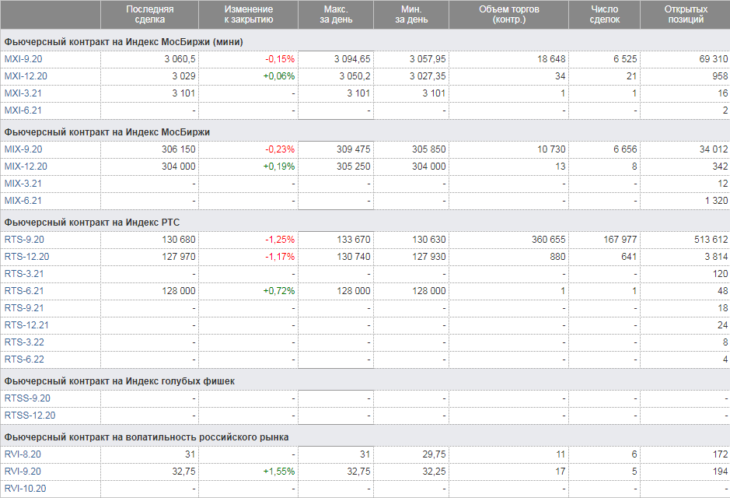
Additionally, many benchmarks form the basis of index funds. The portfolio of such a fund mirrors the composition of the stock benchmark it is based on.
Advantages and Disadvantages of Benchmarks on the Stock Market
Like any other indicator, benchmarks have both advantages and disadvantages.
Advantages include:
- Popularity in the market;
- Simplicity and clarity when used for analysis;
- Accessibility of information about the benchmark.
Along with the advantages, there are certain disadvantages, the main one being subjectivity and not always transparent representation of the state of the industry being analyzed.
When using benchmarks for comparison and evaluation, it is important to remember that this indicator is relative, not absolute. Nevertheless, they remain the most reliable guides for both professionals and beginner investors in the stock market.
FAQ
What is a financial benchmark?
A financial benchmark is a standard used to measure the performance of investments or market sectors.
How do investors use benchmarks?
Investors use benchmarks to compare the performance of their portfolios against a standard, helping them assess whether their investments are performing well.
Are benchmarks reliable for all investors?
While benchmarks are useful tools, they should be used with caution as they are relative and may not always reflect the true state of an industry.