



Fundamental analysis identifies various factors influencing currency exchange rates. Their significance in explaining market fluctuations varies. At the end of the last century, investors closely tracked money supply indicators and budget deficits; in the first half of this century, they gave way to trade balance conditions and interest rate dynamics; currently, global attention focuses on external debt and government borrowing volumes.
However, all fundamental factors are closely interconnected. To forecast currency exchange rate dynamics over medium- or long-term horizons, understanding this interplay is essential. The interest rate differential can help with this.
It represents the difference between key interest rates set by central banks, which serve as crucial tools of monetary policy. For example, when the European Central Bank changes its refinancing rate, it directly impacts interest rates on loans, deposits, and other money market instruments.
Interest Rate Impact on Currency Rates
To understand how a central bank’s decision affects currency exchange rates under normal conditions, consider a real-life analogy. If you have savings in one commercial bank and a nearby bank raises its deposit rate higher than your current one, it makes sense to close your account and switch, assuming both banks have equal reliability.
International investors behave similarly. When one central bank raises its interest rate under normal conditions, boosting money market yields, they trigger capital flows from one economy to another. To buy higher-yielding assets, they must purchase the national currency.
Thus, an increase in the interest rate differential, all else equal, leads to appreciation of the country’s currency. “All else equal” means comparable key macroeconomic indicators between the two economies, primarily inflation and unemployment levels. For instance, in many developing countries, high consumer price index growth necessitates raising the refinancing rate, but this does not attract foreign investors. Banks must still have equal reliability.
Even in comparably developed countries, an increasing interest rate differential does not always strengthen the national currency. During an economic crisis, a shrinking differential can cause currency appreciation. Investors then prioritize capital preservation over growth. Reduced risk appetite boosts demand for low-yield currencies with low central bank rates, as lower yield signals lower risk.
We saw this in 2008, when the mortgage crisis drove investors to safe havens like reliable US Treasury bonds. Dollar demand surged, causing the euro to plummet.
To grasp the interest rate differential’s impact on currency rates, recognize the global economy’s cycle stage. During downturns and recessions, cutting interest rates can strengthen the national currency; conversely, during recovery and expansion, widening the differential supports higher quotes.
Digging deeper reveals tight links between central bank rates and key macro indicators. In a recent Federal Reserve Chair speech, maintaining low key rates until 2014 was discussed.
Republicans criticized the Fed for fueling inflation.
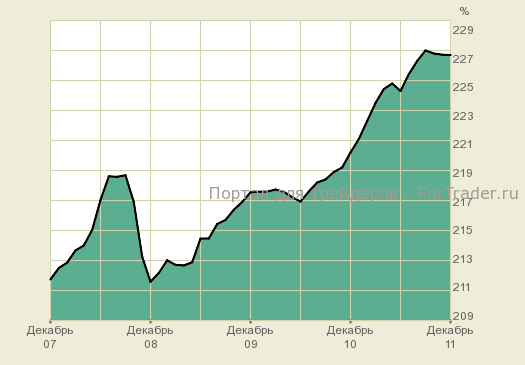
Dynamics of the US Consumer Price Index,%
Low loan rates benefit consumers, boosting goods demand and price growth.
Yet Ben Bernanke stood firm: Federal Funds rates were vital for the recovering economy. Cheap credit was crucial for businesses expanding production, which requires not just funds but labor. This policy could improve the still-troubled labor market. Moreover, low rates cut government debt servicing costs, reaching 93-94% of US GDP.
Thus, the interest rate differential ties closely to macro indicators like inflation, unemployment, industrial production, and more.
How Can Retail Investors Use This Knowledge?
Tracking fundamental dynamics helps predict central bank actions to stimulate economies.
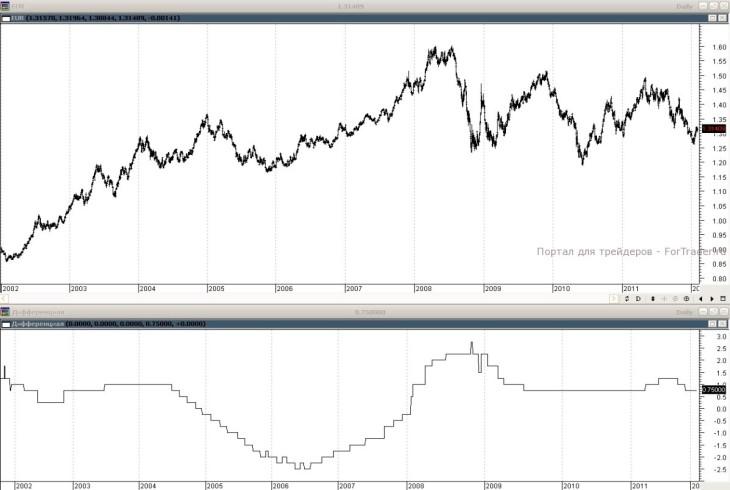
The top chart shows EUR/USD dynamics; the bottom shows the ECB-Fed interest rate differential. A clear correlation exists.
With the Fed planning to hold its key rate steady until 2014, EUR/USD movement hinges on ECB actions. If three-year loans fail to stimulate the economy, the ECB may cut its refinancing rate. What might this mean for the currency rate?
Forecasting based solely on interest rate differentials is unwise; future materials will cover other fundamental factors affecting currency rates.
FAQ
What is an interest rate differential?
The difference between central bank key rates, signaling yield attractiveness for investors and influencing capital flows to currencies.
Why do higher rates strengthen a currency?
Higher rates draw foreign capital seeking better returns, increasing demand for the currency, all else equal like inflation levels.
How do crises change this dynamic?
In recessions, low-rate safe-haven currencies like USD appreciate as investors prioritize preservation over yield amid risk aversion.