



Most people think that to become rich, you need to earn more. In reality, it’s more important to manage what you already have. Compound interest is a principle that turns even small amounts into significant capital if given time.
What Is Compound Interest in Simple Words
Imagine you deposit 100,000 rubles in an account with a 10% annual interest rate. After one year, the bank will add 10,000 rubles in interest, and the total will be 110,000 rubles. If interest was only calculated on the initial amount each year, that would be simple interest. But with compound interest, interest is also calculated on the interest earned.
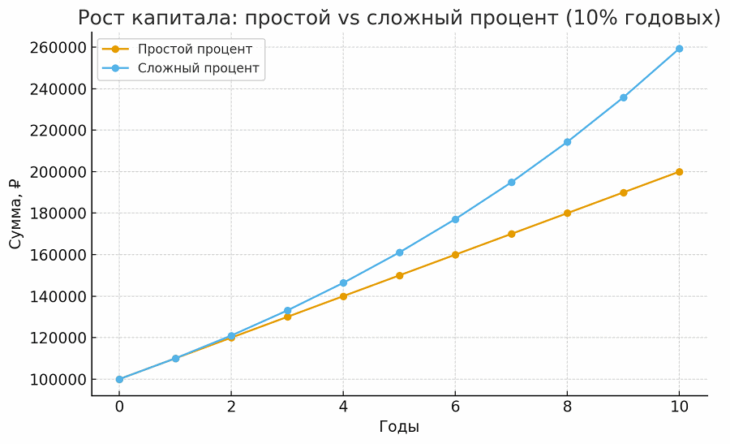
In other words, in the second year, interest will be calculated on 110,000 rubles instead of 100,000 rubles. This means you’ll get a profit of 11,000 rubles instead of 10,000. After three years, the total will be approximately 133,000 rubles, after five years about 161,000 rubles, and after ten years around 259,000 rubles.
This is the key point: investment income grows faster because your capital earns not only on itself but also on its own income. Here is an example table:
| Year | Simple Interest | Compound Interest |
| 1 | 110 000 ₽ | 110 000 ₽ |
| 2 | 120 000 ₽ | 121 000 ₽ |
| 3 | 130 000 ₽ | 133 100 ₽ |
| 4 | 140 000 ₽ | 146 410 ₽ |
| 5 | 150 000 ₽ | 161 051 ₽ |
| 6 | 160 000 ₽ | 177 156 ₽ |
| 7 | 170 000 ₽ | 194 871 ₽ |
| 8 | 180 000 ₽ | 214 358 ₽ |
| 9 | 190 000 ₽ | 235 794 ₽ |
| 10 | 200 000 ₽ | 259 374 ₽ |
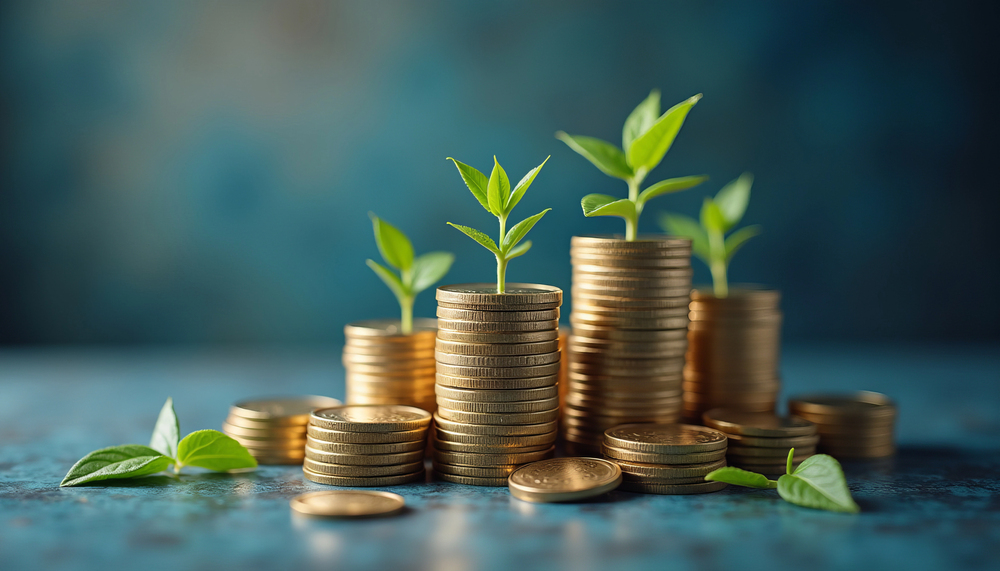
As you can see, the difference in long-term investing is almost 60%. Compound interest is essentially a snowball effect. The longer you leave your savings untouched, the more they grow. Each percentage becomes a new base for the next growth.
This principle works not only in banks but also in investments:
- in dividend stocks where profits are reinvested;
- in government bonds, where coupons are reinvested;
- in exchange-traded funds (ETFs), where income is automatically added to the share value.
The Mathematics of Compound Interest
To understand how money grows with compound interest, it’s enough to grasp one simple formula:
S = P × (1 + r/n)^{n × t}
where:
S — final amount,
P — initial capital,
r — rate (as a decimal),
— number of compounding periods per year,
t — time in years.
The more frequently interest is compounded, the stronger the effect. Annually is standard, monthly is better, and daily is even more advantageous. With the same 10% rate, monthly compounding yields 270,000 rubles instead of 259,000 rubles.
How Inflation and Taxes Affect the Results
Inflation is an invisible enemy of savings. If the return is 10% but inflation is 6%, the real growth is just 4%. Taxes also reduce profits: a 13% income tax is withheld from interest, dividends, and stock profits. For example, 10,000 rubles of income becomes 8,700 rubles after tax. Over decades, this reduces the final amount of savings by tens of thousands of rubles.
To protect yourself:
- use Individual Investment Account (IIS) for tax deductions;
- invest for the long term;
- choose instruments where taxes are only collected upon sale.
The Psychology of Compound Interest
Compound interest works slowly at first and then quickly. Many give up in the early years when growth seems insignificant and stop too soon—right before the curve accelerates.
Investments should become a habit. Regular small contributions are more important than rare large ones. And don’t compare yourself to others—everyone has their own strategy, but the principle remains the same: time + patience = results.
Of course, emotions are the main enemy of investors. Panic during market declines and euphoria during rises prevent compound interest from working. The best solution is to act calmly and systematically.
FAQ
What is compound interest?
Compound interest is when interest is earned on both the initial principal and the accumulated interest over time.
How does compound interest work?
It works by reinvesting the interest earned, allowing your capital to grow exponentially over time.
Why is compound interest important for investors?
Compound interest allows your money to grow faster, as it earns on itself and the interest it generates, leading to higher returns over the long term.