



EN fortrader
24 November, 2025Обновлено 02 December, 2025

Bollinger Bands Plus Moving Average on BB%b

Роман Молодяшин
RU EN

Masterclass: Trading Strategies in Practice – Strategy 7

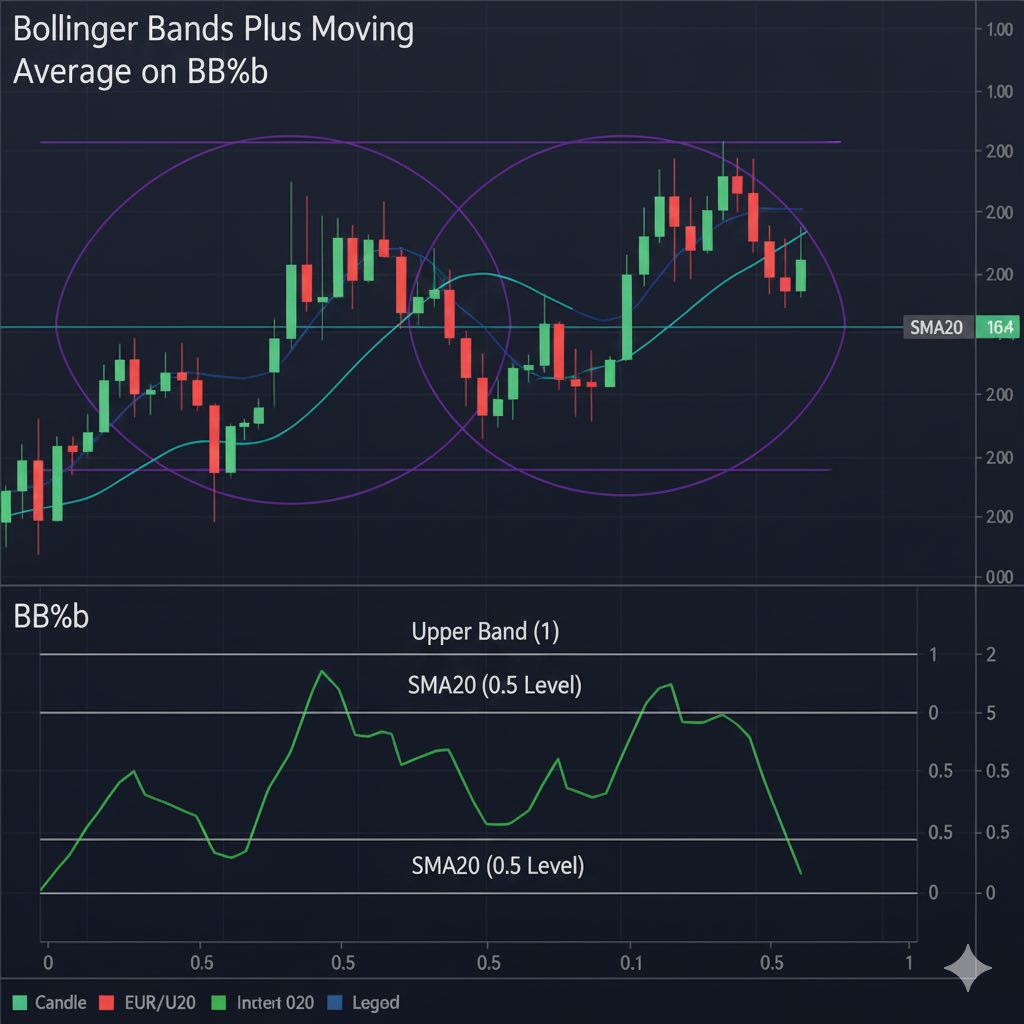
This trading tactic is based on the indicator Bollinger Bands and BB%b. The latter displays Bollinger Bands as levels 0, 0.5, and 1, while the price is shown as an indicator below the chart.

When the chart is dynamic and the price moves with the bands up or down, the indicator window behaves differently: the SMA20, from which the bands are derived, is “stretched” in the indicator window and represents the 0.5 level, with the price oscillating around it; the upper and lower bands correspond to levels 1 and 0 respectively. Therefore, when the price moves beyond the bands, it also crosses levels 1 and 0.

Buy Signal Looks Like This:

First, check the main filter – the EMA89. For a buy entry, it must be rising. Next, the SMA20 of the price (the Bollinger middle band) should also be trending upwards. Another trend direction filter is the 30-period smoothed moving average on BB%b, which must also be rising and positioned above the 0.5 level in the indicator window (blue line).

In an uptrend, entries are taken at lows. Ideally, the price dips below the SMA20 or even touches the lower Bollinger Band. The indicator confirms this signal when its line drops below 0.5 or even below 0, forming a low that marks the end of a correction and the start of the next impulse wave.
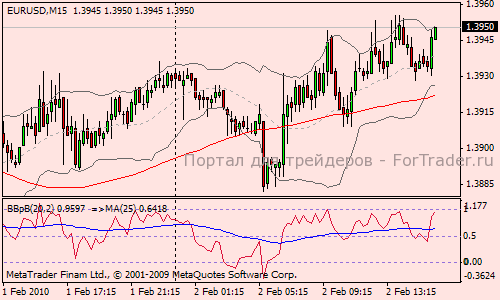
Pullbacks in an uptrend

Fig. 1. Pullbacks in an uptrend.

Mirror signals apply for a downtrend.
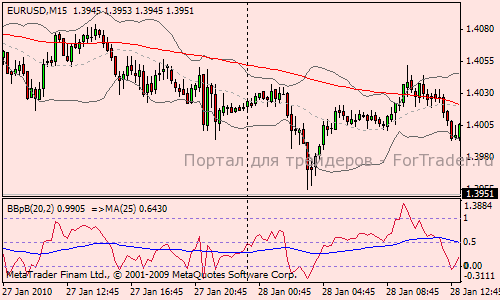
Pullbacks in a downtrend

Fig. 2. Pullbacks in a downtrend.

It is important that all three trend direction filters align. In a bullish trend: EMA89 of price rises, SMA20 of price rises, and the Smoothed MA30 on BB%b is above 0.5 and rising. In a bearish trend, all these work in the opposite direction.

Advantages of the strategy: Trades are opened at the peak of corrections within the trend, entering the next impulse wave. This minimizes the time trades spend in negative territory.

Disadvantages of the strategy: When entering on a correction, there is a risk of catching only the B wave of the correction, which moves in the same direction as the preceding trend. However, the 30-period MA on BB%b crossing 0.5 usually signals the start of a correction or reversal, so trades are not recommended when the MA30 on BB%b moves against the trend.
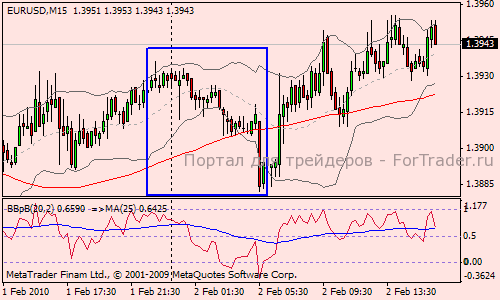
Correction and the role of MA30

Fig. 3. Correction and the role of MA30.

Subscribe to us on Facebook

Fortrader contentUrl Suite 11, Second Floor, Sound & Vision House, Francis Rachel Str. Victoria Victoria, Mahe, Seychelles +7 10 248 2640568

More from this category

All articles

Test on Understanding Forex Market Basics

Test your knowledge of the currency market. Check yourself to identify gaps still affecting your trading.

How Forex Brokers Work Under the Agency Model

In the previous article, we described that the agency model of a Forex broker involves routing ALL client trades to the interbank market. This process is quite complex, involving numerous participants and stages. It encompasses both a technical process for selecting the best prices and executing trades, and a financial one that converts figures into […]

How to Create a Trading Robot If You’re Not a Programmer: 8 Steps from Idea to Implementation

A trader’s brain doesn’t function quite like an ordinary person’s. Someone far from financial markets acts rationally and predictably. But when a person obsessed with candlestick patterns gets involved, the outcomes become much harder to foresee. Common trader flaws include skewed life priorities and heightened impulsiveness. Trading itself becomes the ultimate goal, and the biological […]

The Best Way to Lock Positions: 3 Expert Opinions on Forex Locks

,alignnone size-new-theme-post-size wp-image-233121" src="https://files.fortraders.org/uploads/2017/08/locking-forex-730x379.jpg" alt="Position locking and locks in forex" width="730" height="379" />In order to close a lock, in addition to market analysis and a clear forecast for the currency pair, you need the broker to have suitable conditions for this. For example, some companies do not have the ability to partially close an opposing position, which greatly complicates opening a lock, especially if an equal lock is used.A very common mistake is when a trader opens a locking order of a larger volume than the initial positions in order to reduce losses when the price moves against the initial orders. Such a lock is extremely dangerous: if the price direction changes, the situation will immediately worsen, and losses will grow faster.Also, many traders make a psychological mistake. As soon as any lock trade shows a profit, and there is a possibility that the price will not go further, most traders' nerves fail, and they quickly close the profitable lock position, thereby undermining the structure. When using locking in your trading, you need to know well how to exit it correctly.As market analysis shows, non-retracement (or with minor corrections) price movement in one direction of more than 500 pips occurs only 1-2 times per year. To set a lock at this level, the account drawdown should be no more than 45%, otherwise there will not be enough free funds to open an opposing order. Statistically, the probability of a pullback at this level is several times higher. Therefore, it is better to "sit out" such moments than to set a lock. Of course, you can set a lock without waiting for a non-retracement trend of 500 pips. But in this case, you will constantly be in a suspended state and deal with locks. In most cases, when you are mentally ready to set a lock, the price will be on the verge of a reversal.The expediency of using position locking in Forex is absent. Whatever the situation with the currency pair, the alternative to a lock will always be a stop-loss or simply "sitting out" losses with averaging at important levels.Furthermore, do not forget that if swaps are negative, such a lock will only increase losses, and on some currency pairs, the size is very significant. Yes, one of the swaps may be positive, but even in this case, the size of the negative will be larger, and losses will still increase.The only acceptable option for a reasonable trader to use a lock is to set it not on a losing trade, but on a profitable one. When an open position is generating good profit but a correction is approaching, instead of closing the trade, you can set a lock, thereby fixing the profit. At the moment when the price resumes movement in your favor, the opposing order is closed, and the profit on the previously opened trade continues to grow. It is psychologically much easier to work with such a lock than with a losing one.

Recent educational articles

All articles

The editor recommends

All articles
Loading...