What Is a Timeframe in Trading and How to Choose the Right One
A timeframe in trading is the time interval used to form each candle or bar on a price chart. Choosing the right timeframe determines your trading style, trade frequency, market noise levels, and signal accuracy, so understanding differences between M1, H1, H4, and D1 is essential for traders.
Standard Timeframes in MetaTrader 4

MetaTrader 4 and 5 terminals offer these standard timeframes:
- 1 minute – M1
- 5 minutes – M5
- 15 minutes – M15
- 30 minutes – M30
- 1 hour – H1
- 4 hours – H4
- 1 day – D1 or Daily
- 1 week – W1 or Weekly
- 1 month – MN or Monthly
Other platforms may include timeframes like M10, M20, H2, or Y (year). Software tools also allow creating custom timeframes.
Timeframe names indicate the size of their basic elements, with higher timeframes composed of lower ones. For example, the chart shows EUR/USD price action from 9:00 to 10:00 on M15 and H1, where one H1 candle equals four M15 candles.
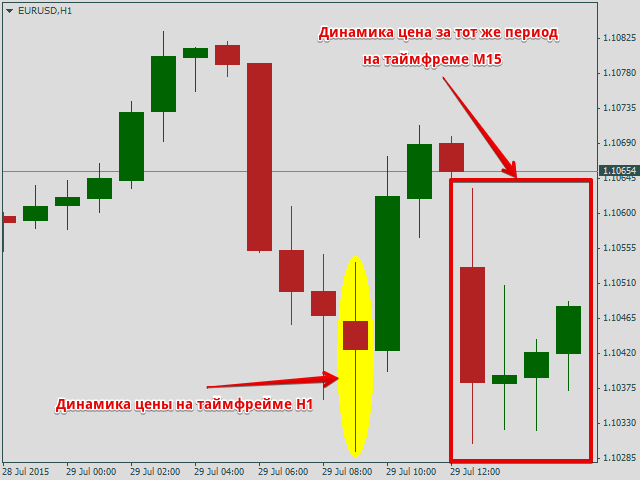
Comparison of price dynamics on different timeframes
The key is that a timeframe represents a set of minimal elements, not complete data for the full period.
How to Set Up Timeframes in MetaTrader 4
To display the desired timeframe in MetaTrader 4, go to View > Toolbars and check Graph Period.
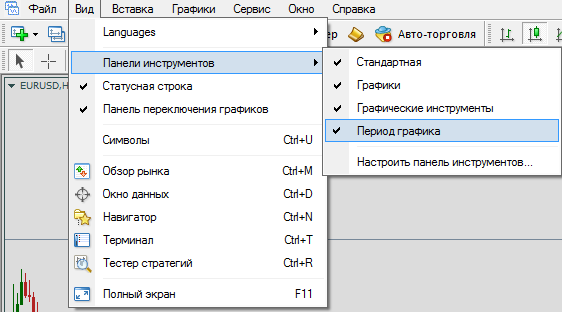
Graph period setup
This enables buttons for standard timeframes on the terminal panel.

Standard MetaTrader 4 timeframes
How to Choose the Right Timeframe for Trading
Selecting a timeframe depends on your trading style and trade volume. Short-term moves appear on lower timeframes, while long-term trends show on higher ones.
Forex traders classify timeframes by style:
- M1 to H1: Intraday trading or day trading, including scalping. Involves many trades per day, all closed same-day. Not recommended for beginners due to high stress and fast decisions.
- H1 to H4: Swing trading. Trades last hours to days.
- H4 to MN: Position trading. Trades open for weeks.
Lower timeframes generate more frequent signals and trades but smaller profits per trade (a few pips), requiring constant monitoring, emotional control, and higher risk.
Higher timeframes offer fewer signals but larger profits per trade with less noise.
Why Timeframes Matter in Forex Trading
Skilled traders analyze multiple timeframes before entering trades, confirming signals like indicator readings, support/resistance breaks, or chart patterns across intervals. This approach is outlined in Dr. Alexander Elder’s Triple Screen Trading System.
Multi-timeframe indicators (often labeled MTF for multi-timeframe) display trend direction and strength from various timeframes, aiding analysis.
FAQ
What is the best timeframe for beginners?
H1 or H4 timeframes suit beginners, offering fewer signals, less noise, and manageable trade frequency without constant monitoring.
How do multiple timeframes improve trading?
Analyzing higher timeframes for trend direction and lower ones for entries confirms signals, reducing false trades as in Elder’s Triple Screen system.
What are standard MT4 timeframes?
M1, M5, M15, M30, H1, H4, D1, W1, MN cover intraday to monthly views for all trading styles.