


Volatility in financial markets measures the speed and magnitude of price changes in assets like stocks, currencies, or commodities, indicating the level of risk and uncertainty in investments.
It is a key indicator for traders and investors, influencing decision-making strategies and risk management. High volatility signals turbulent market periods with sharp price swings driven by news or events, while low volatility points to stability and predictability.
Contents
- Volatility – This Is…
- What Volatility Means on the Forex Market
- Key Aspects of Volatility on Forex
- Types of Volatility
- High vs Low Currency Volatility
- Key Features of Volatility
- How to Use Volatility in Forex Trading
Volatility – This Is…
Volatility – instability in market conditions, demand, and prices, often due to insufficient liquidity, meaning assets cannot be sold quickly near market price.
Volatility is the most important financial market indicator. It characterizes the level of uncertainty or risk associated with an asset’s price change. Comparisons typically use average annual or monthly figures from past periods.
What Volatility Means on the Forex Market
Volatility on the Forex currency market is the degree of change in currency pair rates over a specific period. It shows how actively currency prices fluctuate and indicates market risk levels.
Higher volatility means more significant rate swings, creating greater profit opportunities but also increasing trader risks.
Forex volatility can be measured in pips or as a percentage of the initial price value.
Important: Volatility is best understood as the magnitude of deviation from the existing trend. If a trend shows strong growth with fluctuations within the trend channel, the instrument is not considered volatile.
Key Aspects of Volatility on Forex
- Forex volatility is influenced by economic data (e.g., GDP, unemployment, inflation), political events (elections, government changes), central bank decisions (interest rate changes), and global crises or natural disasters. Account for these when deciding to buy or sell a pair.
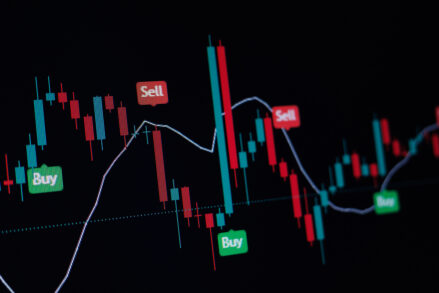
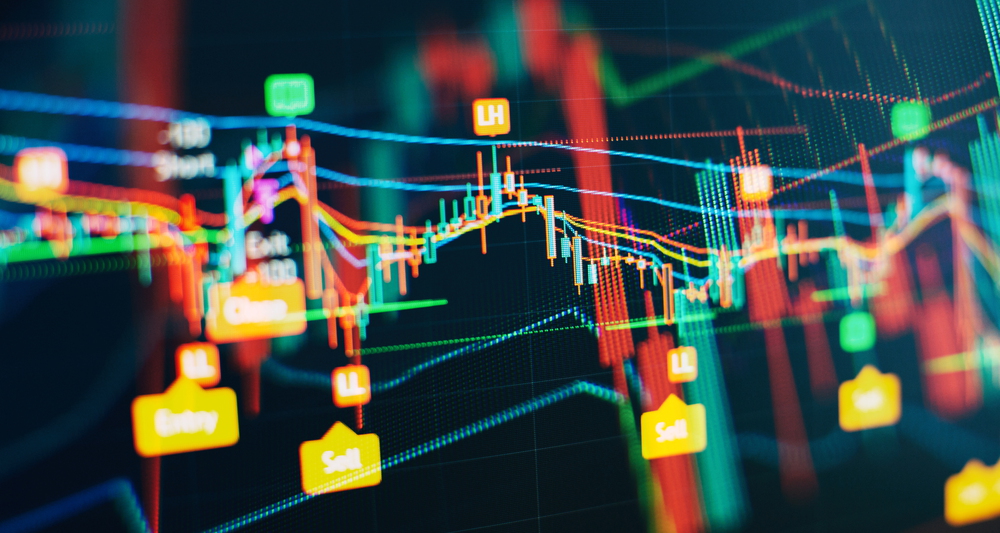
- Indicators like standard deviation or Average True Range (ATR) assess it. Analyze daily price ranges—the difference between high and low for the day—using charts.
- High volatility offers more short-term trading opportunities from rapid price swings but demands strict risk management, such as stop-losses and position size limits.
- Historical volatility uses past price data; implied (expected) volatility reflects current market expectations of future swings. Consider both in trading.
Types of Volatility
Two main types of volatility are distinguished:
- Historical. The standard deviation of an instrument’s price over a period, based on past price change data.
- Implied (Expected). Deviations calculated from the current price, assuming market value reflects potential risks.
High vs Low Currency Volatility
No standard thresholds exist, but traders often use these benchmarks:
- Low Volatility. Currency rate changes 2-3% (up or down) over one trading week compared to the prior week’s close.
- High Volatility. Currency rate changes around 15% over one trading week from the prior week’s close.
Markets vary in aggressiveness. A 2-3% change may be high for some stocks, while 15-20% daily moves are standard in cryptocurrencies and often ignored by traders.
Key Features of Volatility
Forex currency pair volatility has these features:
- Volatility is cyclical—it builds to a maximum, then fades to a minimum.
- Volatility is persistent—not just cycling, but repeating patterns. If price moves in a range today, it likely continues tomorrow.
- Volatility mean-reverts. After hitting extremes, it returns to average. If the range is 1% minimum to 4% maximum, average is around 2% most of the time. Use this to calculate entry and exit points.
How to Use Volatility in Forex Trading
Volatility is crucial for risk assessment in Forex trading, requiring adjustments to lot sizes and leverage in margin trading.
Using historical data and forecasting implied volatility, apply these rules to boost strategy effectiveness:
- Select currency pairs based on trading session, time of day, and expected volatility.
- Do not use volatility to gauge trend strength or direction.
- Volatility can arise from sustained directional moves or small-range fluctuations.
Session-specific volatility knowledge improves trading:
- European session—volatile European pairs: GBP/JPY, USD/CHF, GBP/USD, GBP/CHF.
- American session—GBP/CHF, GBP/JPY, USD/CHF.
- Pacific session—yen pairs: GBP/JPY, USD/JPY, EUR/JPY, and cross GBP/CHF.
Higher volatility means more profit potential, but extreme levels increase trading risks.
Download Forex Volatility Indicators
FAQ
What causes high volatility on Forex?
Economic data releases, central bank decisions, political events, and global crises drive sharp price swings in currency pairs.
How do you measure volatility in trading?
Use indicators like Average True Range (ATR), standard deviation, or daily price range (high minus low).
Is high volatility good or bad for traders?
It offers profit opportunities from big moves but requires strict risk management like stop-losses due to increased loss potential.